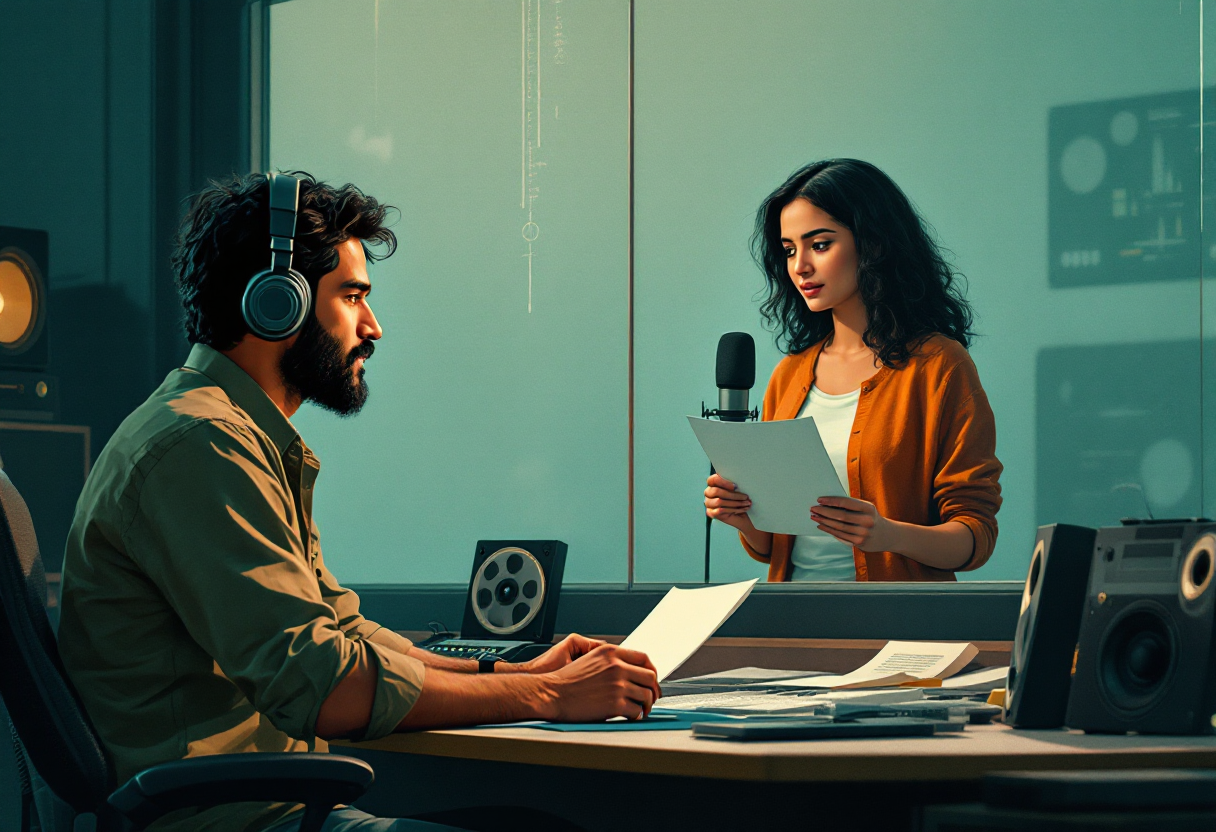
Arjun is finishing Night Ferry. Maya recorded its temporary narration. A vendor offers to reproduce her voice for new lines; another offers Nova, an invented voice with no identifiable real-person counterpart. Both use software. That does not make their permission questions the same.
Your task is to help Arjun identify the identity, check the applicable protections, and prepare a responsible release. This lesson is educational, not legal advice; a real production needs advice about its contracts, locations and uses.
THE RUNNING PROJECT Night FerryArjun’s narration decision
Arjun produces. Maya performs. Nova is the invented alternative.
You’ll learn toBrief learner objectives: classify the performer; map the protections; spot consent and pay issues; separate law from proposals; choose a responsible workflow.
Whose identity is in the output?
01 / A real person reproduced
Digital replica
A digital replica reproduces an identifiable real individual's voice, face or likeness. It may be built from a scan, a recording or other source material. Maya need not visit a scanning booth for Arjun's generated new lines to raise replica questions.
02 / No identifiable counterpart
Synthetic performer
A wholly synthetic performer has no identifiable real-person counterpart. Nova is invented, rather than a substitute performance recognizable as Maya. Calling a file “synthetic” does not settle that question. Check what the output actually reproduces; legal and contractual definitions differ.
Maya: an identifiable person. A generated performance in her recognizable voice raises replica questions.
A new name. The same voice.
The vendor renames Maya's cloned voice Nova. Listeners still recognize Maya. A new product name does not turn a replica into an invented performer. Conversely, a general vocal style is not automatically an identifiable person's voice. Arjun needs provenance and an identity review, not a marketing label.
Training and identity are separate questions. Even a genuinely invented output does not prove its training material was licensed or that platform terms permit Arjun's planned use.
0 / 3 evidence reviews
Vendor product name
Nova
Reproduces Maya’s recognizable voice
▂ ▄ ▆ ▃ ▇ ▅ ▃ ▆ ▂ ▄ ▇ ▃ ▆ ▄ ▂
Vendor product name
Nova
No identifiable real-person counterpart
▂ ▄ ▆ ▃ ▇ ▅ ▃ ▆ ▂ ▄ ▇ ▃ ▆ ▄ ▂
Vendor product name
Warm storyteller
General style only; source unclear
▂ ▄ ▆ ▃ ▇ ▅ ▃ ▆ ▂ ▄ ▇ ▃ ▆ ▄ ▂
Classify this output
The vendor calls its output Nova, but it reproduces Maya's recognizable voice saying new lines. How should Arjun classify it?
A new name does not remove the identifiable person from the output. Try again.
Correct. Identity, rather than the product name, drives this distinction.
New generated lines are not simply playback of Maya's recorded performance. Try again.
Check the production, too.
Arjun checks whether Night Ferry is covered by the applicable SAG-AFTRA agreement. Union membership alone does not establish production coverage. Contract protections apply within their coverage; state rights may apply alongside them. On a non-covered production, the union contract is not automatically the rulebook.
“Neither” means a particular contract or identity statute may not apply to these facts. It is not a finding that nobody has rights or that the use is cleared.
Production coverageContractWhich agreement covers this production and use?
Jurisdiction + factsApplicable lawWhich rights apply alongside the deal?
Coverage comes from the production’s applicable agreement.
What protects this?
1
Whose identity?
2
Which production?
Your protection route
Two questions. Different obligations.
Choose a performer type, then production coverage.
Route 01
Replica · covered
Replica + covered: investigate applicable contract consent and payment rules alongside identity law and other rights. Maya's voice remains hers to authorize within the relevant rules.
Next: read the agreement and define Maya’s intended use.
Route 02
Replica · non-covered
Replica + non-covered: the union agreement does not automatically supply protection. Investigate applicable state identity rights, the actual deal and other law; do not assume a protection gap clears the use.
Next: identify the relevant state rights and actual deal.
Route 03
Synthetic · covered
Synthetic + covered: a real person's replica consent may not be the issue, but the 2026 agreement has synthetic-use obligations, including union notice and bargaining in specified circumstances. Check those provisions.
Next: check the agreement’s synthetic notice and bargaining terms.
Route 04
Synthetic · non-covered
Synthetic + non-covered: no automatic TV/Theatrical contract protection. Check provenance, licenses, platform terms and applicable law; if an identifiable person emerges, revisit the classification.
Next: verify provenance, licenses and platform terms.
This is an issue map, not an automated legal clearance. Coverage and jurisdiction require more facts than two selections.
Consent has a scope.
For Maya's replica on a covered production, Arjun must address clear, informed written consent describing the intended use, plus the applicable compensation rules. A vague “all AI uses” sentence is not a reliable substitute for the agreement's requirements. Creation, use and later reuse need the checks the agreement specifies; exceptions and details matter.
Arjun describes the new narration and its context to Maya before proceeding. Owning her old audio file does not by itself authorize new words in her identity.
Creation→Use→Reuse
The recording is an asset. The voice belongs to a person.
Specific use. Clear context. Informed permission.
Pay now. Recheck the next use.
Compensation for covered replica work and residuals depend on the agreement, replica category and use. Residuals are additional contract payments for specified exploitation or reuse, not a universal royalty on every generated line. Arjun budgets the initial use and checks later uses separately.
When marketing requests a new trailer line, Arjun rechecks the scope and applicable payment rules before generating it. Fair pay is an ethical commitment even where a particular union formula does not apply.
→
Film narration: described use approved. A different use requires its own review.
Route the new trailer request
Some boundaries cannot be signed away.
The 2026 agreement expressly addresses replicas made without a separate scan and includes enforcement protections. It is not a blanket ban on every AI technique.
Covered-production boundary
For the younger character in Night Ferry, Arjun must not use a minor's digital replica to depict nudity or simulated sexual activity under the covered agreement, including through aging up or de-aging. A permission form cannot override this contractual prohibition.
Pause the proposed use. Permission cannot override a contractual prohibition.
Maya authorized the described film narration. Marketing now requests new generated dialogue for a trailer. What should Arjun do first?
A related project does not establish the scope of consent or payment. Try again.
Payment and permission are separate issues. Try again.
Correct. Recheck the actual permission and agreement before a changed use.
Outside the contract: state protections.
CA
AB 2602
California AB 2602 concerns enforceability of certain digital-replica provisions in personal or professional services contracts. Description of intended uses and legal or union representation matter. It is not a general ban on AI voices or a nationwide permission system.
TN
ELVIS Act
Tennessee's ELVIS Act adds voice to protected personal rights and addresses specified unauthorized uses and distribution. Exceptions, including protected expressive uses, matter. Arjun checks the applicable state's rules and facts rather than choosing whichever state's name sounds most protective.
A services contract and a recorded voice can raise different rights questions.
A bill is not an enacted right.
The federal NO FAKES Act remains proposed legislation in the reviewed record. The 2026 Senate bill is S.4591; its committee progress does not make it enacted law. Arjun cannot rely on a proposed nationwide framework as today's clearance. Verify current status before a real release.
US protection remains a patchwork. The absence of one comprehensive identity rule does not erase other applicable federal, state or contractual duties.
S.4591Proposed federal framework • reviewed record
1Introduced
2CommitteeProgress ≠ enactment
3Chambers
4Enacted
What can Arjun rely on today?
An overseas release adds a layer.
If Night Ferry reaches Europe, national personality rights can protect identity, while EU data and digital rules may add duties. These are overlapping frameworks, not one uniform European performer contract.
The Digital Services Act concerns online-service responsibilities, including mechanisms for reporting illegal content; it does not itself grant Arjun the performer's consent. The AI Act has transparency duties for specified synthetic content and deepfakes, with scope and exceptions. Disclosure does not replace permission.
An overseas release requires a new review of the applicable frameworks.
IdentityNational personality rightsPlatformsDSA processesTransparencySpecified AI Act duties
Night Ferry is not union-covered. Which conclusion is justified?
Correct. Leaving the contract does not remove other legal duties.
A bill's title and progress do not make it enacted law. Try again.
Disclosure and identity permission do different jobs. Try again.
Run Arjun’s release desk.
First establish whose identity and source material are involved. Then confirm production coverage and relevant jurisdictions. Record specific permissions, intended uses, compensation and applicable residual arrangements. Check the vendor's training, retention and reuse terms; restrict access to replica assets.
Before release, apply required disclosures and platform rules, and keep a record of what was approved. If the use changes, revisit consent and pay before generating or publishing. Informed consent, transparent rules and fair pay are a durable ethical baseline; a checklist does not guarantee legal clearance.
Night Ferry / Release record0 / 3 issues resolved
Open an unresolved issue and decide which evidence Arjun needs.
Resolve Identity
Resolve Permission + pay
Resolve Platform + data
The workflow loops
New request: generate dialogue for a different campaign
Take the right questions to the next project.
Arjun’s two questions
Arjun's first question is “Whose identity?” His second is “Which rules cover this use?” A replica and an invented performer can trigger different obligations; covered productions and state laws can overlap. Before releasing Night Ferry, document permission, pay and platform requirements, and recheck any changed use.
Educational, not legal advice. Rules and bill status can change; consult the current sources and qualified counsel for a real production.
Keep the permission, pay and platform record with the production.
Short glossary
Digital replica: a digital reproduction of an identifiable real person's voice, face or likeness; exact definitions vary.
Synthetic performer: an invented digital performer with no identifiable real-person counterpart; contractual definitions may be narrower.
Consent: informed permission for a described creation or use, in the form the applicable rules require.
Residuals: additional payments for specified exploitation or reuse under an applicable agreement.
Personality rights: legal protections for aspects of personal identity, such as name, voice or likeness; scope varies by jurisdiction.
Next: 5 questions • pass at 80% • feedback at the end
Assessment
Assessment Starting
You are about to begin the assessment. Select the best answer for each question.
Arjun generates new lines recognizable as Maya from her old recordings. Which fact best supports treating the output as a replica?
Nova has no identifiable real-person counterpart. Night Ferry is covered by the 2026 TV/Theatrical agreement. What should Arjun investigate?
Arjun proposes aging up a minor's replica to depict simulated sexual activity on a covered production. Which response follows the agreement?
Arjun sees that the NO FAKES bill advanced in committee. What does that establish?
A vendor offers Arjun a voice license but will not explain its source or retention terms. What is the best next step?
Certificate of completion
V / F
Voices, Faces and Consent.
Completed with at least 80% on the five-question assessment. Educational, not legal advice.
US-focused creator education • Night Ferry production review
Your production review
Your results
0%
Question 1
Arjun generates new lines recognizable as Maya from her old recordings. Which fact best supports treating the output as a replica?
Question 2
Nova has no identifiable real-person counterpart. Night Ferry is covered by the 2026 TV/Theatrical agreement. What should Arjun investigate?
Question 3
Arjun proposes aging up a minor's replica to depict simulated sexual activity on a covered production. Which response follows the agreement?
Question 4
Arjun sees that the NO FAKES bill advanced in committee. What does that establish?
Question 5
A vendor offers Arjun a voice license but will not explain its source or retention terms. What is the best next step?